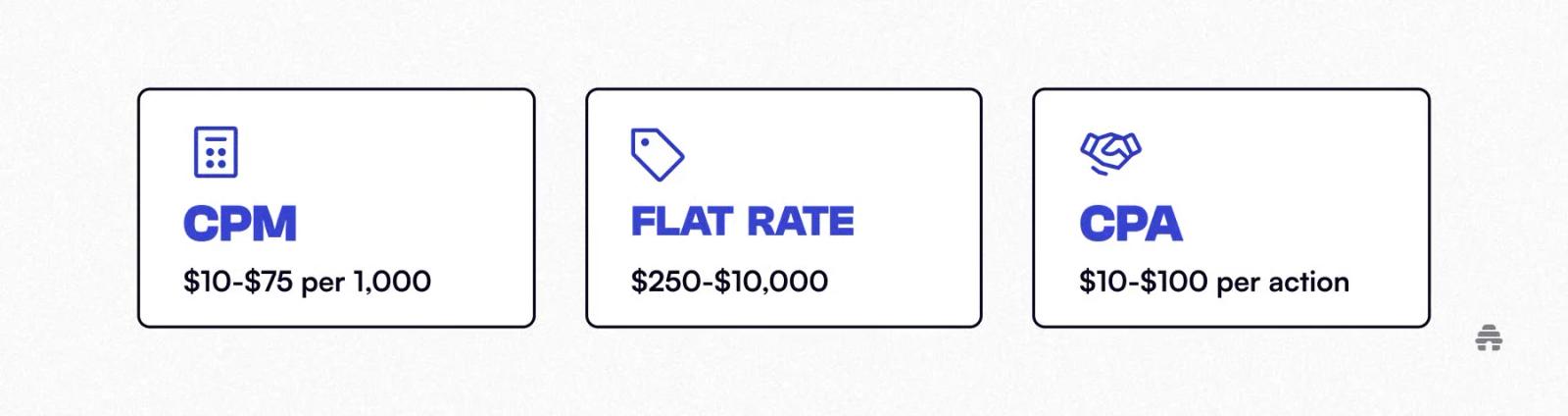
A CPM deal pays the creator per thousand organic views their sponsored video delivers. A flat-rate deal pays the creator a fixed fee agreed up front, regardless of views. A third model, CPA, pays per attributed action (signup, install, purchase) rather than per view. CPM and flat rate cover the vast majority of YouTube sponsorships. CPA shows up less often on YouTube but is worth knowing about because it reshapes who carries the downside risk when a video underperforms.
This post is one piece of the pillar guide to YouTube creator sponsorships. Pricing model sits between format and contract terms. The format sets the shape. The pricing model sets who wins when views deviate from expectation.
How each one actually works
Flat rate
The brand and creator agree a fee up front based on expected views. The creator produces the video, the brand pays the agreed amount, the end. No tracking of views required after publish, no payment reconciliation, no makegood drama (unless a view guarantee is layered on separately).
Flat rate is the default for most integrations under $10,000. It's what creators prefer for predictable cash flow. It's what brands prefer for predictable budgeting. It's the right answer 70 percent of the time.
CPM
The brand pays $X per 1,000 organic views within a measurement window (usually 30 to 45 days from publish). Rates vary wildly by niche. Industry benchmarks for 2026 put finance and B2B SaaS CPMs at $40 to $100, tech $30 to $70, health and fitness $30 to $50, lifestyle $20 to $40, gaming $15 to $35, and entertainment $15 to $30.
CPM deals need three protective clauses to work:
- A view guarantee: the creator commits to a floor so the brand isn't paying for nothing
- A measurement window: usually 45 days, the cutoff for when views count
- A cap: the maximum the brand will pay, usually 25 to 50 percent above the target spend
Without the cap, a viral video costs the brand much more than they planned. Without the guarantee, a flop costs the creator their production time for almost no payment.
When each model wins
Flat rate wins when
The creator's views are consistent. If the creator's last 10 videos average within 20 percent of each other, flat rate is cleaner. Both sides know what the video will land. No need to track views for payment.
The deal is small. Under $5,000 in total fees, the overhead of tracking CPM views, confirming makegood clauses, and running measurement doesn't pay for itself. Flat rate, move on.
The campaign is one-off. Building a reconciliation process for a single video is friction. For ongoing monthly campaigns, CPM's admin cost is absorbed. For one-shot campaigns, it's just overhead.
The brand cares about specific deliverable shape. Brands running dedicated videos or ambassador programs need specific deliverable commitments (video length, talking points, on-screen time). Flat rate pairs with detailed briefs better than CPM does.
CPM wins when
The creator's view counts are inconsistent. If the creator's recent 10 uploads vary from 50k to 500k, flat rate is guessing. CPM aligns brand cost to actual performance and protects against the low-view scenario.
The brand wants to scale spend based on reach. Some brands want to spend more on the creators who deliver more and less on the ones who don't. CPM does this automatically. Flat rate requires the brand to manage tier lists and adjust rates per creator per campaign.
Multiple creators run simultaneously with varying view counts. If a brand is running 10 creators in a month with expected reach anywhere from 100k to 2M views, CPM evens out the spend-to-reach ratio across the roster. Flat rate leaves the brand overpaying the low-volume creators and underpaying the high-volume ones.
CPA (the third option, less common on YouTube)
A CPA deal pays the creator per attributed action, not per view. Typical action events: a signup, an install, a confirmed sale via promo code or UTM link. Benchmarks vary wildly; some reference rates put newsletter-style CPA at $10 to $100 per action, but YouTube CPA deals usually price higher per action because tracking is noisier and creators bear more of the conversion risk.
CPA on YouTube is rare as a standalone model because the measurement infrastructure has to be airtight, the creator has to trust the brand's attribution reporting, and the creator carries the entire risk if the offer converts poorly. Most brands that want pay-for-performance on YouTube use the hybrid model below instead: flat fee plus a per-action bonus. That protects the creator's downside while still aligning spend to outcomes.
The hybrid model: flat + performance bonus
A growing pattern in 2026 is the flat-rate-plus-bonus structure. The creator gets a guaranteed flat fee for production and views, plus a per-conversion bonus tied to attributed signups, installs, or sales.
Example: $2,000 flat fee plus $2 per tracked signup. A video that converts 500 signups pays $3,000 total. A video that converts 2,000 signups pays $6,000. The creator has a floor; the brand has upside-aligned spend. Good for freemium products, free trials, and app installs where conversion is clean to track.
The hybrid model needs two things to work: a clean attribution link (unique UTM per creator or promo code redemption tracked server-side), and a reporting cadence both sides trust. Without those, the bonus becomes a dispute waiting to happen.
What usually trips brands up
Confusing flat rate with no risk. A $10,000 flat rate deal where the creator delivers 30k views on a 300k-average channel is still a loss for the brand. Flat rate without a view guarantee transfers ALL the downside to the brand. Layer a view guarantee on top of flat rate if the creator's numbers are flaky.
Setting CPM too low. Brands who've done Meta Ads think YouTube CPMs should be similar ($5 to $15). They're not. Organic creator-driven CPMs in 2026 run $20 to $80 in most commercial categories because the conversion is higher per view. A $10 CPM offer on a tech channel gets ignored.
Paying CPM on promoted views. Some creators boost their sponsored videos through YouTube Ads or external traffic. Those views look like real views in YouTube Studio but aren't the audience the brand paid for. Any CPM contract should specify "organic views only, as reported by YouTube Studio, excluding promoted traffic."
Quick answers
Which model should a first-time sponsorship brand use? Flat rate, with a layered view guarantee set at 60 percent of the creator's recent average. This gives the brand price predictability and downside protection without the CPM tracking overhead.
What's a reasonable CPM for a tech YouTube creator? $30 to $70 per 1,000 organic views in 2026, depending on specifically how B2B the audience is. Developer tools and enterprise SaaS run toward the top of that band. General consumer tech runs lower.
Can I change pricing models mid-campaign? Not within the same deal. Renegotiating a creator's fee structure after a video is live is a relationship damaging move. Change the structure on the next campaign, not mid-flight.
What happens on a flat-rate deal if the video over-delivers? Brand gets the upside for free. The creator agreed a fee; they get paid that fee regardless of whether the video lands 50k views or 2M. Some creators negotiate a bonus clause for over-delivery; most don't.
What happens on a CPM deal if the video goes viral? The cap kicks in. Most CPM contracts have a cap 25 to 50 percent above the expected target spend. Above the cap, the brand stops paying, and the creator gets the remaining views as free upside for their channel. Don't sign a CPM deal without a cap.
Want to see which model fits your next campaign? Tell us what you're trying to hit and we'll model both sides of it for you.